





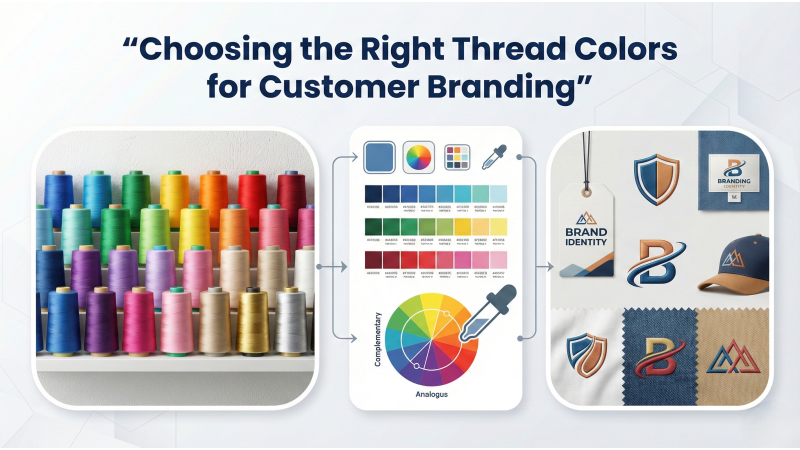
Choosing the Right Thread Colors for Customer Branding
Thread color selection is one of the most influential steps in professional embroidery. When working with global brands across the USA, Europe, the Middle East, Russia, Africa, and Asia, color accuracy becomes even more critical. A logo that is just a few shades off can weaken brand identity and reduce customer trust. Mastering color harmony ensures every stitch reflects the client’s true visual signature, whether you’re producing uniforms, corporate merchandise, high-end apparel, or promotional items.
For deeper understanding of color theory in embroidery, explore advanced insights on practical thread color harmony and professional color-matching workflows. These resources provide visual demonstrations that complement the techniques discussed below.
1. Match Colors Using Official Brand Guidelines
Start with the customer’s official brand codes — Pantone, CMYK, RGB, or Hex. These codes are your anchor when translating digital colors into thread shades. Many professional embroiderers reference specialist guides such as the comparison insights explained in Pantone vs. Thread Chart Matching, which break down the differences between printed and stitched color reproduction.

When brand codes aren't available, ask for a high-resolution vector logo. This minimizes errors that commonly arise from mobile-screen screenshots or compressed social-media images.
2. Use High-Quality Thread Color Charts
Physical color cards remain the gold standard for accurate color selection. Thread sheen, undertones, and light reflection cannot be judged accurately on screens. To understand why physical charts outperform digital references, review professional guidance such as Mastering Madeira Thread Colors and the in-depth exploration at HoopTalent’s Madeira Color Matching Guide. Both highlight how lighting conditions and thread material influence perceived color.
Always compare shades under daylight or neutral LED lighting to avoid warmth shifts from yellow bulbs.
3. Test Stitch Samples Before Final Approval
A stitched sample remains the most reliable proof of accuracy. Even perfectly matched charts cannot predict how a specific fabric absorbs color. Always:
- Stitch a test run on the exact fabric you will use for production.
- Submit the swatch to the client for approval.
- Archive approved swatches to maintain long-term consistency across future orders.
This workflow dramatically reduces errors, returns, and production delays — essential for maintaining your reputation with enterprise clients.
4. Consider Fabric Color, Thickness, and Texture
Fabric characteristics can shift thread appearance significantly:
- Dark fabrics may mute mid-tone threads unless reinforced with a white underlay.
- Satin or glossy textiles enrich color vibrancy due to light reflection.
- Textured materials scatter light differently, sometimes requiring slightly lighter or darker thread adjustments.
Understanding fabric–thread interaction is crucial when aiming for strict brand consistency across multiple apparel types.
5. Use Color Conversion Tools (But Carefully)
Color conversion charts bridge the gap between digital color codes and actual thread numbers. However, as confirmed by professional studies such as the Thread Color Harmony Tips and Thread Color Matching Guide, conversions are approximations. Always confirm the final shade with a physical sample before production.
6. Maintain a Library of Customer Color Profiles
A detailed archive of approved thread numbers, swatches, fabric notes, and machine settings saves time, reduces errors, and ensures consistent output for repeat customers. High-volume embroidery operations across corporate and industrial sectors depend heavily on this type of internal color-management database.
Advanced Thread Color Resources
Below are authoritative references for mastering thread color theory and precision color matching:
- Pantone vs. Thread Charts
- Thread Harmony Tips for Embroidery
- Professional Thread Matching Guide
- Madeira Thread Mastery
- Madeira Color Card Expertise
YouTube Tutorials for Visual Color Matching Techniques
Final Thoughts
Thread color matching is not merely a technical step — it is a precision-driven branding decision. With proper tools, professional guidelines, physical charts, and a structured approval process, your embroidery output will consistently meet global brand expectations. This approach reduces corrections, enhances customer satisfaction, and strengthens your reputation as a dependable embroidery service provider.
By practicing careful color evaluation, leveraging expert resources, and maintaining clear communication with clients, you ensure that every stitch carries the brand’s true identity with accuracy and pride.
Leave a comment