





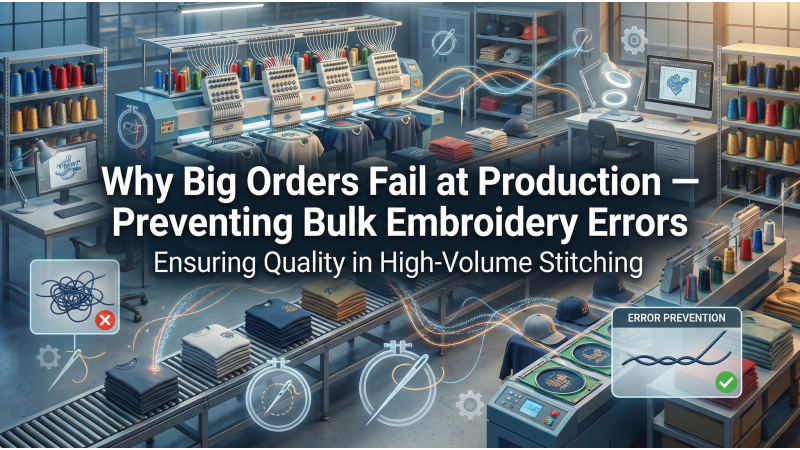
Why Big Orders Fail at Production — Preventing Bulk Embroidery Errors
Bulk embroidery production seems simple until you actually begin stitching hundreds of pieces. A tiny issue that barely matters in a single shirt can turn into a disaster when multiplied across large runs such as school uniforms, boutique collections, festival outfits, and corporate apparel. Many businesses discover these problems only after garments are damaged or deadlines are missed.
To fully understand how bulk embroidery behaves in the real world, you can also explore practical examples in this detailed video lesson available on YouTube and review common financial mistakes found in the Embroidery Legacy financial guide. These insights help you learn why efficiency, digitizing quality, and precision workflow matter more in bulk orders than in small custom jobs.
1. Poor Digitizing Quality for Bulk Jobs
Digitizing is the foundation of every embroidery project. When producing hundreds of pieces, the digitized file must be optimized for repetition. A design that looks fine on one sample can easily fail during continuous stitching if the density, underlay, or pull compensation is incorrect.
Using the right patterns and design styles is crucial. For example, if you're creating large decorative pieces, study the structure of professional applique bulk embroidery designs to understand how clean cut edges and minimal jumps improve efficiency. Neckline or kurti work can follow principles used in neck bulk embroidery digitizing where heavier outlines are balanced with the right underlay to prevent distortion.
Designs with long borders must maintain consistent stitch flow, which is why observing well-crafted big border bulk embroidery designs helps you understand how density is managed for long runs. For intricate detailing like lace, study how lace bulk embroidery patterns use lighter stitches to avoid thread breaks during large batches.
2. Incorrect Hoop Tension & Fabric Handling
Hoop tension inconsistencies cause fabric distortion, misalignment, and outline shifts. When producing hundreds of garments, even slight changes in hooping pressure become noticeable.
Traditional garments like blouses often require tight consistency in hooping, so analyzing structured templates from bulk blouse embroidery formats can guide you in maintaining accuracy. For panel-based outfits such as kalis, examine kali bulk embroidery files that demonstrate how repeat sections must align perfectly across the fabric.

3. Machine Condition & Maintenance Issues
Bulk orders demand a well-maintained machine. Problems like skipped stitches, thread breaks, and tension imbalance escalate quickly when stitching hundreds of garments.
When doing all-over embroidery jobs, reviewing structured layout ideas from detailed allover bulk embroidery patterns can help you plan ahead for long stitching cycles, reducing heat buildup and preventing unnecessary thread strain.
4. Lack of Proper Testing Before Full Production
Skipping test runs is one of the biggest reasons bulk embroidery jobs fail. A complete test using the correct stabilizer, fabric, hoop, and thread ensures that no unexpected issues appear during mass production.
If your job includes dresses or multi-panel outfits, reviewing structured formats like dress bulk embroidery design collections helps you understand how professionals test multi-layer placements and verify final measurements before stitching hundreds of pieces.
5. No Quality Control (QC) Checkpoints
Without QC checks, errors go unnoticed until many garments have already been stitched incorrectly. QC avoids mass rejection, costly rework, and customer dissatisfaction.
Elements such as hem and border placement can be inspired by structured layouts found in daman bulk embroidery designs where alignment matters greatly in bulk production.
6. Using Wrong Stabilizer or Thread Type
The wrong stabilizer causes puckering, distortion, and misalignment — problems that increase dramatically during bulk stitching. Consistent use of the same stabilizer brand, thickness, and thread type is crucial for large production runs.
Decorative items like wall pieces and home decor are particularly sensitive to stabilizer selection. You can observe how density is balanced by studying bulk wall art & flower applique patterns, which show how stabilizers support heavy stitch areas in decorative stitch-outs.
7. Human Error in Repetitive Tasks
Human fatigue leads to wrong placement, hooping mistakes, misplaced stabilizer, or stitching the wrong design on a garment. Bulk production requires well-organized workflow systems.
Using sorting techniques, color batching, and guided placement tools helps reduce fatigue-based errors during long production cycles.
Conclusion
Bulk embroidery production is not just about scaling up — it’s about upgrading your workflow, digitizing standards, machine maintenance routines, and quality control systems. When all these aspects work together, even large orders become smooth, predictable, and profitable.
If you want to explore structured bulk designs, long-form patterns, and applique collections to improve your understanding of large-scale production, browse professional resources such as the applique bulk catalog, border structures, neckline collections, and lace bundles available across trusted embroidery platforms.
With the right strategy, digitizing approach, and testing habits, you can deliver bulk orders on time, minimize errors, and build a strong reputation in the embroidery industry.
Leave a comment