





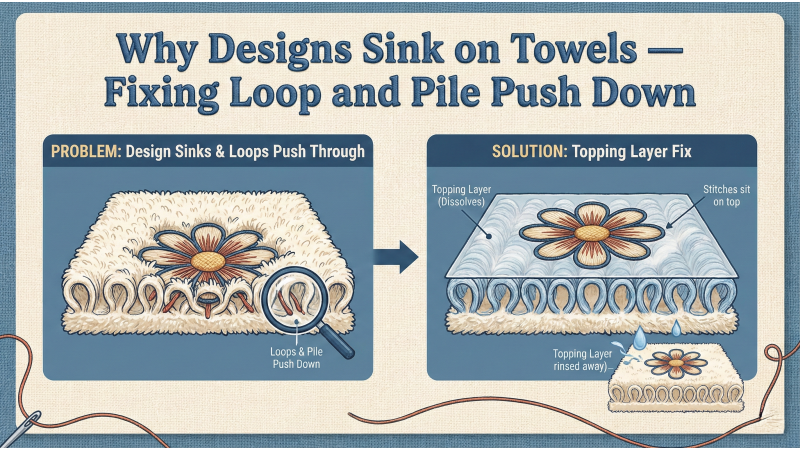
Why Designs Sink on Towels — Fixing Loop & Pile Push Down
Towel embroidery behaves like an unpredictable landscape — soft hills of terry loops rising and falling beneath your stitches. These loops act like tiny springs, pushing upward and swallowing your design if it isn’t digitized correctly. Even the most beautiful artwork can disappear into the plush surface unless you intentionally prepare for the towel’s texture.
This long-form guide explores exactly why towel embroidery sinks, how to prevent it, and which expert-level techniques ensure your stitches sit proudly above the pile. Along the way you'll find essential towel-embroidering resources and practical tutorials to help you achieve professional results.
1. Why Towels Swallow Embroidery Designs
The terry loops of a towel are not passive — they rise, shift, and fight back during stitching. This movement can cause:
- Loops rising above the stitch line — covering small letters and fine details.
- Fabric movement — misaligning outlines and shapes.
- Uneven compression from high-density stitches.
- Weak stabilizer support that allows fabric flex.
- Incorrect digitizing without proper underlay.
To counteract sinking, your design must be digitized and stabilized to stay elevated on the towel. For a clear starting point:
Ricoma — How to Embroider Towels

2. Choosing the Right Stabilizer
Towels need a stable foundation that prevents shifting and stops the pile from creeping upward.
Medium or Heavy Cut-Away Stabilizer
- Medium-weight cut-away — ideal for monograms and small logos.
- Heavy cut-away — best for large fills or designs with high stitch counts.
Avoid tear-away stabilizers because they shift or rip and encourage sinking. For beginner-friendly preparation tips:
EMDigitizing — Start Embroidery on Towels
Water-Soluble Topping (WSS)
WSS creates a barrier between stitches and loops, preventing the pile from poking through. It is essential for small text, fine logos, delicate monograms, and thin satin outlines. It tears away easily and washes out cleanly.
3. Thread Tension Adjustments
Thread tension controls whether stitches float above the towel or get dragged into it. Use:
- 10–20% lower top tension so stitches rest on top.
- Normal bobbin tension for balanced stitching.
Balanced tension prevents sinking and keeps surfaces smooth during long runs.
4. The Underlay Foundation Towels Need
Underlay acts as a scaffold beneath your visible stitches. Towels require strong, intentional underlay to control loops.
Underlay Types That Work Best
- Zig-zag underlay — compresses loops and smooths the surface.
- Edge-run underlay — anchors outlines and prevents drifting.
- Double underlay — stabilizes large satin or fill areas.
For fluffy towels or detailed designs, a knockdown stitch can improve clarity. Learn more here:
Embrilliance — Knockdown Tutorial
5. Density Settings for Towels
Too much density crushes the towel unevenly. Too little allows loops to rise through the stitching.
- Satin stitch density: 0.40–0.45 mm
- Fill stitch density: approx. 3.5–4.0 (depends on software)
For small text, enlarge letters or increase spacing for readability.
6. Correct Hooping Technique
Towels shift easily, so good hooping is essential:
- Use cut-away stabilizer beneath the towel.
- Hoop firmly without stretching.
- Add a basting box to lock everything in place.
- Float thick towels with adhesive stabilizer if necessary.
Proper hooping eliminates distortion and reduces sinking.
7. Choosing Needles & Threads
Use sharp needles that penetrate loops cleanly. For general fabric-to-needle guidance:
Recommended Needles
- 75/11 sharp — small text and finer details
- 80/12 or 90/14 sharp — thicker, plush towels
Thread Type
Polyester embroidery thread is best due to durability and colorfastness. Rayon sinks more easily and may fray.
8. Essential Use of Water-Soluble Topping
WSS is almost mandatory for towel embroidery. It prevents loops from rising and keeps edges clean.
For a visual walkthrough:
Towel Embroidery Step-by-Step (YouTube)
9. Pro Tips to Prevent Sinking
- Baste around the design for stability.
- Avoid lettering smaller than 7–8 mm.
- Use bold satin fonts for clarity.
- Use high-quality towels to avoid collapsed fibers.
- Always test on a scrap before final stitching.
10. When to Use Knockdown Stitching
Knockdown stitching pre-compresses the pile with a light mesh-like fill. Use it for fluffy towels, detailed designs, or small fonts.
For design inspiration and project ideas:
Ricoma — Embroidery Ideas & Inspiration
Conclusion
Towel embroidery sinks because terry loops rise through the stitch line, fabric shifts under the needle, and incorrect digitizing leaves stitches unsupported. By using firm cut-away stabilizers, intentional underlay, lower top tension, sharp needles, and water-soluble topping, your embroidery will remain crisp and elevated above the towel surface.
For business-friendly ideas and popular embroidery products, explore:
Leave a comment